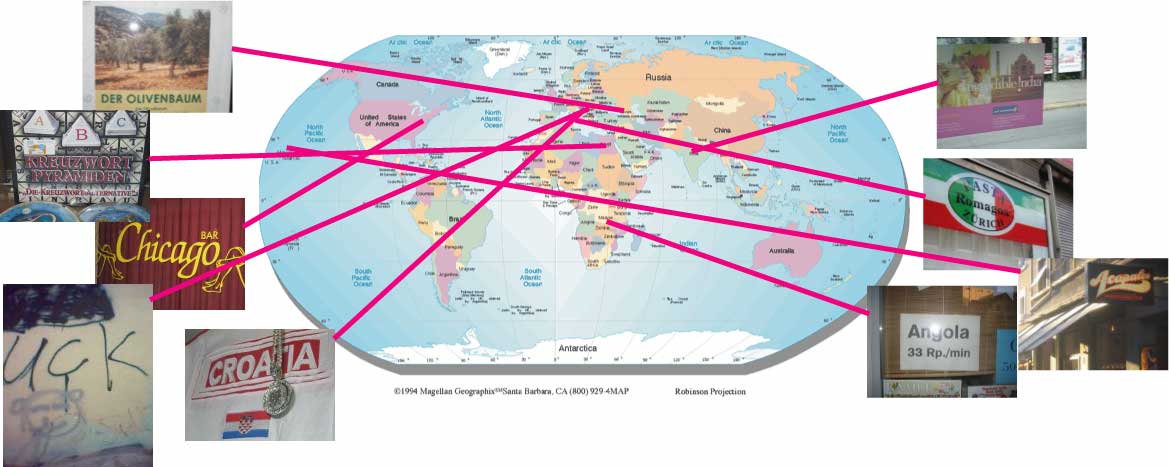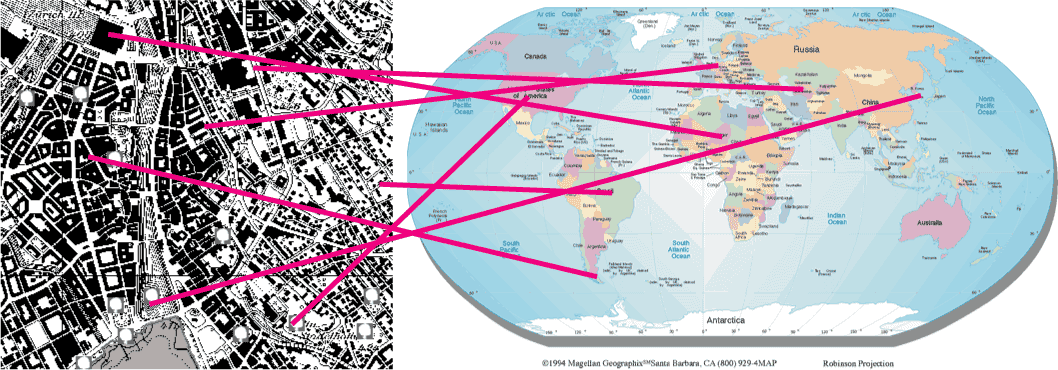
following situationist ideas of psychogeography
and drifting – for example to use a map of another city to orient
in the one you are currently physically present – to a more asymmetric
level by setting in direct relation local space to places on a global
map. images present in the city's semiosphere work as reference points
from the local space to global places. mentally these references already
get constructed during your everyday moves in the city. the game can make
this circumstance more explicite and explore how it emerges.
one result is a gap between where i am physically and where i am on the
global scale/map: by walking from one reference point to another one you
might jump from india to south africa and so on. somehow it's breaking
down the myth of virtual cyber as an everywhere present space to the city's
sphere.
the local space or its reception becomes reconfigured while questions
emerge about how countries/foreign places are associated personally and
how they get represented in the local city.
if these images aren't already, they become part of your navigation systems.
and to find out which images are interpreted as references to 'outer spaces'
is an explorative approach.
does the circumstance of places being linked globally to each other mean
that there is a process of deterritorialisation or denationalisation going
on?
saskia sassen plays down this thesis which also became popular with theories
of virtual cyberspace. instead she claims a simultaneous process of decentralisation
and concentration which construct "global cities": new centers
emerge and centralism stays a key concept of the economic system even
if the regions or nations around the centers might get less important
to them. these new (business) centers are nodes within a network of transactions
and streams. global cities are the places where globalisation (or these
process of decentralisation and concentration) materializes: transnational
companies and migrants find their way to and inscribe new images into
the city. so the question of how this condensition gets visible must be
posed.
why a game?
the game scenario gives possibility to players moving in between two orientation
systems; the local city and the global which are melt together in the
images of reference.


http://www.furious.com/perfect/situationism.html
The idea of ‘drifting’ has its roots in the tradition of the
‘flaneur’ A stroller or dandy spectator of the Parisian scene
who had emerged in the early nineteenth century and later celebrated by
the likes of Charles Baudelaire. Like the flaneur, the drifter skirts
the old quarters of the city in order to experience the flip side of modern
urban life. In a prescient passage describing Dickens’ ‘nightwalks,’
Walter Benjamin wrote:
‘Whenever he had done drudging he had no other resource but drifting
and he drifted over half London... he did not go in for "observation",
a priggish habit. He did not look at Charing Cross to improve his mind
or count the lamp-posts in Holborn to practice his arithmetic...Dickens
did not stamp these places on his mind: HE STAMPED HIS MIND ON THESE PLACES’
Wandering around the city, drifting without destination, neither going
to work nor properly consuming was a waste of time in the temporal economy,
in a society where "time is money." In response, the situationists
denounced alienation and extolled revolution, promoting their motto Ne
travzaillez jamais (Never work).
Whether discovered in the city or the mind, for the situationists, psychogeography
and drifting mapped out revolutionary desire.
http://www.heise.de/tp/r4/artikel/6/6005/1.html
Immer wieder wird behauptet, daß der Cyberspace und die in ihm
agierende globale Ökonomie urbane Zentren überflüssig machen.
Saskia Sassen, die den Begriff der "Global Cities" geprägt
hat, hingegen beobachtet gleichzeitig einen Dezentralisierungs- und einen
Konzentrationsprozeß. In ihrem Beitrag arbeitet sie die verschiedenen
Gesichter der neuen Zentralität heraus, die mit einer Marginalisierung
von breiten Gesellschaftsschichten einhergeht und sich auch auf die Eigenschaften
der Netze auswirkt.
Die grundlegende Behauptung in diesem kurzen Essay geht dahin, daß
Zentralität weiterhin eine Schlüsseleigenschaft des ökonomischen
Systems bleibt, aber daß die räumlichen Korrelate der Zentralität
durch die neuen Technologien und durch die Globalisierung tiefgreifend
verändert wurden.
http://www.urban75.com/Action/seattle7.html
There are 25 million milk producing animals in Mongolia, but in the city
market place you can only buy German butter. Similarly last year Britain
exported 47 million kilograms of butter to Europe while importing 43 million
kilograms from the same countries. In one of Southern England's prime
dairy farming counties, Devon, New Zealand butter is a quarter of the
price of local butter. It's insane.
http://squat.net/de/berlin/stadtbau/global.html
Die Stadt, die Region gewinnt dabei an Bedeutung; sie ist der Ort, an
dem die Globalisierung sich "verräumlicht" und konkret
wird. Das internationale Kapital konzentriert dabei in sog. "Global
Cities" seine Macht und seine Finanzen. Gleichzeitig kommen Teile
der Peripherie als Flüchtlinge in eben diese Zentren.
"Die Welt Städte sind Motoren der Internationalisierung, insofern
sie Magnete für Einwanderung und Kapitalinvestitionen sind, aber
auch insofern aus ihren Zitadellen heraus die Unterwerfung anderer Orte
und Regionen auf dem Globus geplant und exekutiert wird. Sowohl externer
Imperialismus als auch interne Kolonisierung (auch der immigrierten Bevölkerung)
sind das Hauptgeschäft der World City" (6: Kipper, Stefan; Keil,
Rogen 1995: Urbanisierung und Technologie in der Periode des Globalen
Kapitalismus. In: Hitz, Hansruedi et al. (Hg.) 1995: Capitales Fatales
Urbanisierung und Politik in den Finanzmetropolen Frankfurt und Zürich.
Zürich: Rotpunkt S. 61 89.)